Policy Brief 3 ·
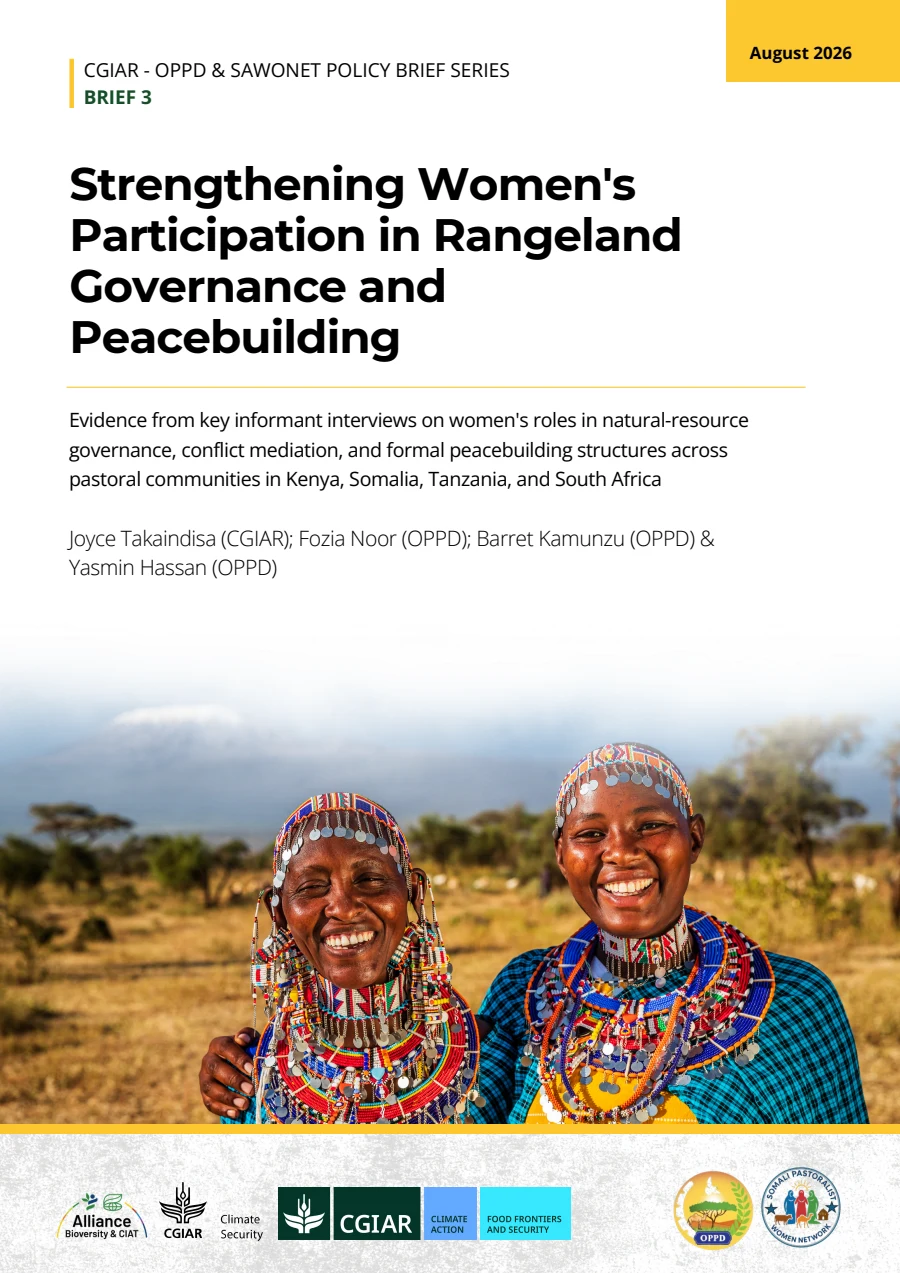
Strengthening Women's Participation in Rangeland Governance and Peacebuilding
Evidence from key informant interviews on women's roles in natural-resource governance, conflict mediation, and formal peacebuilding structures across pastoral communities in Kenya, Somalia, Tanzania, and South Africa
- Authors
- Joyce Takaindisa (CGIAR); Fozia Noor (OPPD); Barret Kamunzu (OPPD); Yasmin Hassan (OPPD)
- Series
- CGIAR, OPPD & SAWONET Policy Brief Series
- Research countries
- Kenya, Somalia, Tanzania, South Africa
- Publication
- August 2026 · Brief 3
- Format
- PDF · 17 pages · 14.6 MB
Executive summary
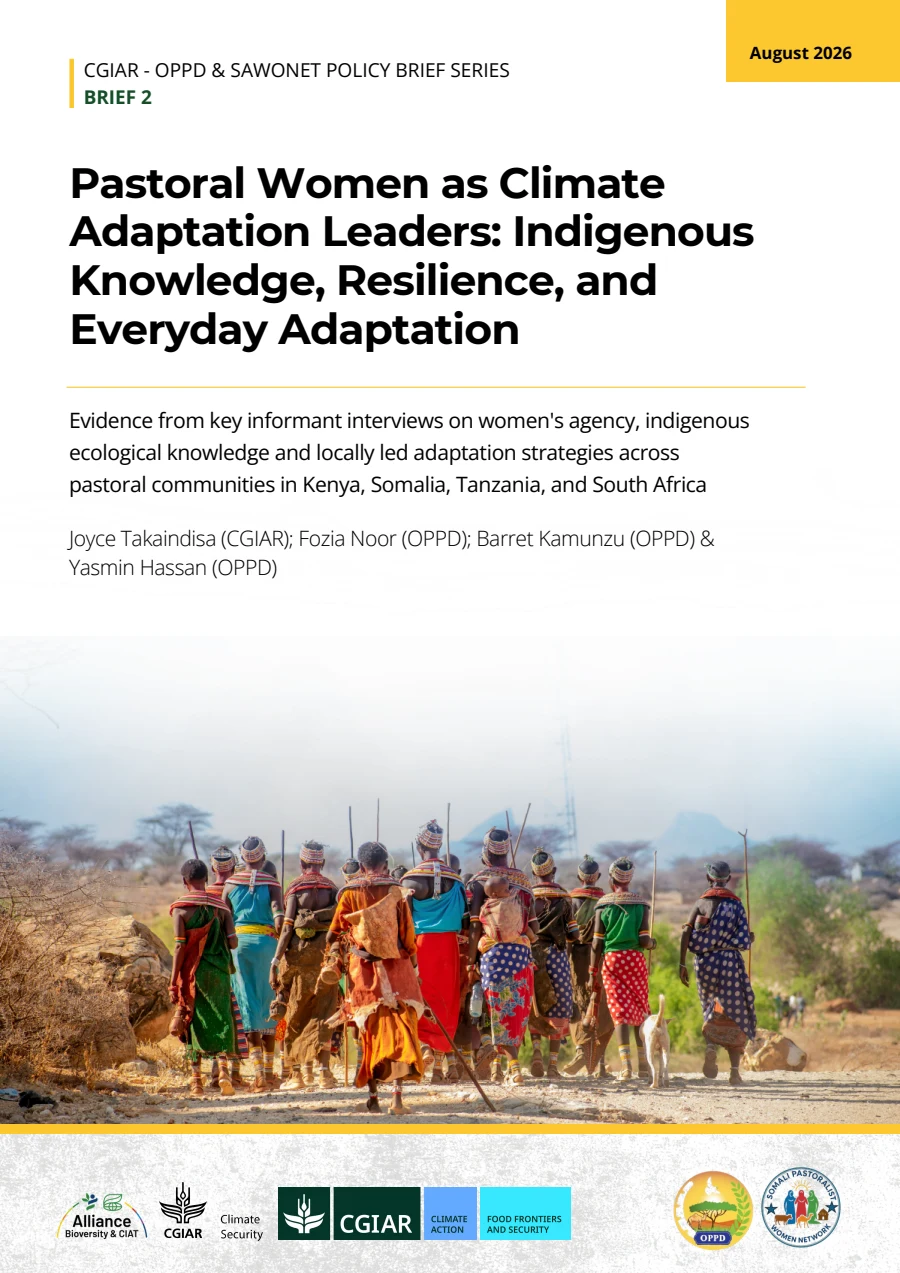
Across the study's interviews, women are described as mediators, counsellors and organizers who sustain social cohesion across ethnic and clan lines. Their contributions largely occur outside formal peace committees, elders' councils and natural-resource bodies. The brief argues that durable peace and sustainable rangeland management require institutions to recognize, resource and give real authority to women's existing leadership, with reforms tailored to local barriers.
Condensed from the original brief. Read the PDF for the complete evidence, analysis and references.
Key findings
- Women mediate disputes, support reconciliation and mobilize community dialogue, often before formal institutions become involved.
- Formal governance remains predominantly male; patriarchal norms, literacy barriers, financial dependence, restricted mobility, unpaid care work and intimidation constrain participation.
- Land and resource rights are prominent barriers in Kenya and Tanzania, while exclusion in Somalia is more closely associated with clan leadership and formal institutional arrangements.
- Positive examples of formal inclusion are associated with greater trust, more equitable resource access and stronger conflict resolution. Meaningful participation requires enforceable rights, information, finance and authority.
Policy recommendations
- Guarantee formal seats and voting rights for women in peace and resource governance, supported by information, finance, enforceable rights and public participation benchmarks.
- Adapt participatory rangeland management approaches that build women's inclusion into decision-making from the outset.
- Resource cross-border coordination and community peace platforms and include women mediators from their founding stages.
- Tailor reforms to context: address land and resource rights in Kenya and Tanzania and representation within and alongside clan-based structures in Somalia.
- Provide sustained support to existing women's mediation networks and address literacy, financial dependence, mobility and unpaid care constraints.
Citation & attribution
Takaindisa, J.; Noor, F.; Kamunzu, B.; Hassan, Y. (2026). Strengthening Women's Participation in Rangeland Governance and Peacebuilding: Evidence from key informant interviews on women's roles in natural-resource governance, conflict mediation, and formal peacebuilding structures across pastoral communities in Kenya, Somalia, Tanzania, and South Africa. CGIAR Climate Security, Organization for Pastoral Peace Development (OPPD).
Joint series: CGIAR, OPPD & SAWONET Policy Brief Series. The original citation identifies CGIAR Climate Security and Organization for Pastoral Peace Development (OPPD).
© 2026 CGIAR Climate Security. The original PDF retains all copyright notices, license statements, source citations, photo credits and institutional disclaimers.
Related publications
Explore the other available briefs in this joint series.