Policy Brief 2 ·
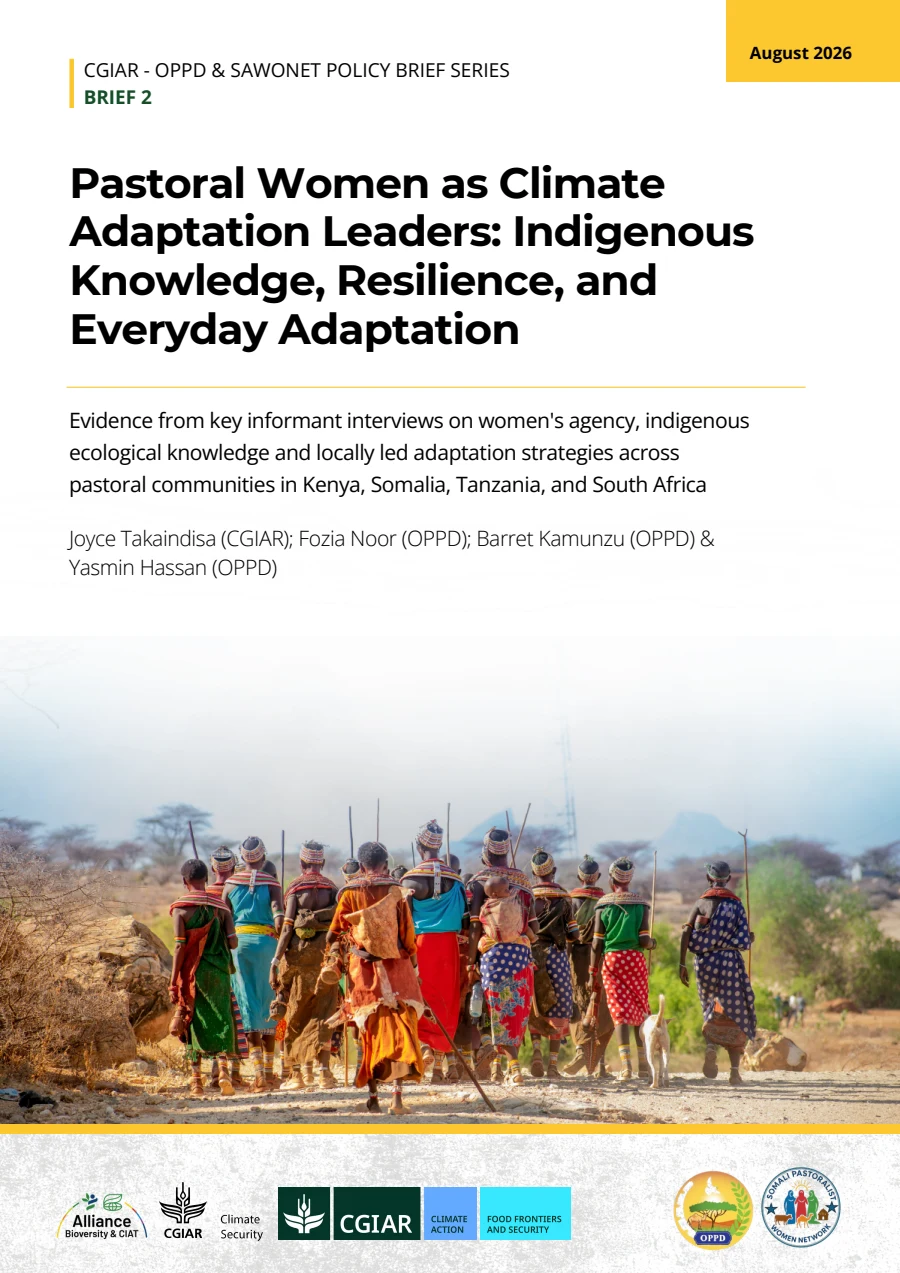
Pastoral Women as Climate Adaptation Leaders: Indigenous Knowledge, Resilience, and Everyday Adaptation
Evidence from key informant interviews on women's agency, indigenous ecological knowledge and locally led adaptation strategies across pastoral communities in Kenya, Somalia, Tanzania, and South Africa
- Authors
- Joyce Takaindisa (CGIAR); Fozia Noor (OPPD); Barret Kamunzu (OPPD); Yasmin Hassan (OPPD)
- Series
- CGIAR, OPPD & SAWONET Policy Brief Series
- Research countries
- Kenya, Somalia, Tanzania, South Africa
- Publication
- August 2026 · Brief 2
- Format
- PDF · 17 pages · 11.2 MB
Executive summary
Pastoralist women already lead everyday adaptation through ecological knowledge and practical livelihood strategies. Interviews with 20 organizations across the four study countries describe expertise in weather, water, livestock health, seeds and rangelands, alongside savings groups and community networks. This leadership remains largely informal and unsupported. The brief calls for direct finance, recognition of knowledge holders and partnerships that strengthen existing women-led institutions.
Condensed from the original brief. Read the PDF for the complete evidence, analysis and references.
Key findings
- Women hold and transmit practical ecological knowledge through sustained environmental engagement and intergenerational learning.
- Everyday adaptation includes milk sales, petty trade, poultry keeping, savings groups, food preservation, seed saving and water conservation, often without external technical or financial support.
- Repeated shocks erode the assets, time and social networks that sustain adaptation, pushing coping strategies toward emergency survival.
- Women's ecological knowledge is largely excluded from formal early warning, extension services, research and curricula, while locally led groups struggle to access finance and institutional partnerships.
Policy recommendations
- Create dedicated, flexible, multi-year funding and direct small-grant channels for women-led savings groups, cooperatives and community organizations; track the finance reaching them.
- Strengthen livestock-centered diversification and value chains and expand index-based livestock insurance to protect herd assets.
- Support women-led documentation of indigenous knowledge with intellectual and cultural protections, and co-design early-warning systems with knowledge holders.
- Invest in locally developed combinations of indigenous knowledge and digital information sharing, and support intergenerational knowledge transmission.
- Channel support through trusted existing women's networks, savings groups and cooperatives.
Citation & attribution
Takaindisa, J.; Noor, F.; Kamunzu, B.; Hassan, Y. (2026). Pastoral Women as Climate Adaptation Leaders: Indigenous Knowledge, Resilience, and Everyday Adaptation: Evidence from key informant interviews on women's agency, indigenous ecological knowledge and locally led adaptation strategies across pastoral communities in Kenya, Somalia, Tanzania, and South Africa. CGIAR Climate Security, Organization for Pastoral Peace Development (OPPD).
Joint series: CGIAR, OPPD & SAWONET Policy Brief Series. The original citation identifies CGIAR Climate Security and Organization for Pastoral Peace Development (OPPD).
© 2026 CGIAR Climate Security. The original PDF retains all copyright notices, license statements, source citations, photo credits and institutional disclaimers.
Related publications
Explore the other available briefs in this joint series.