Policy Brief 4 ·
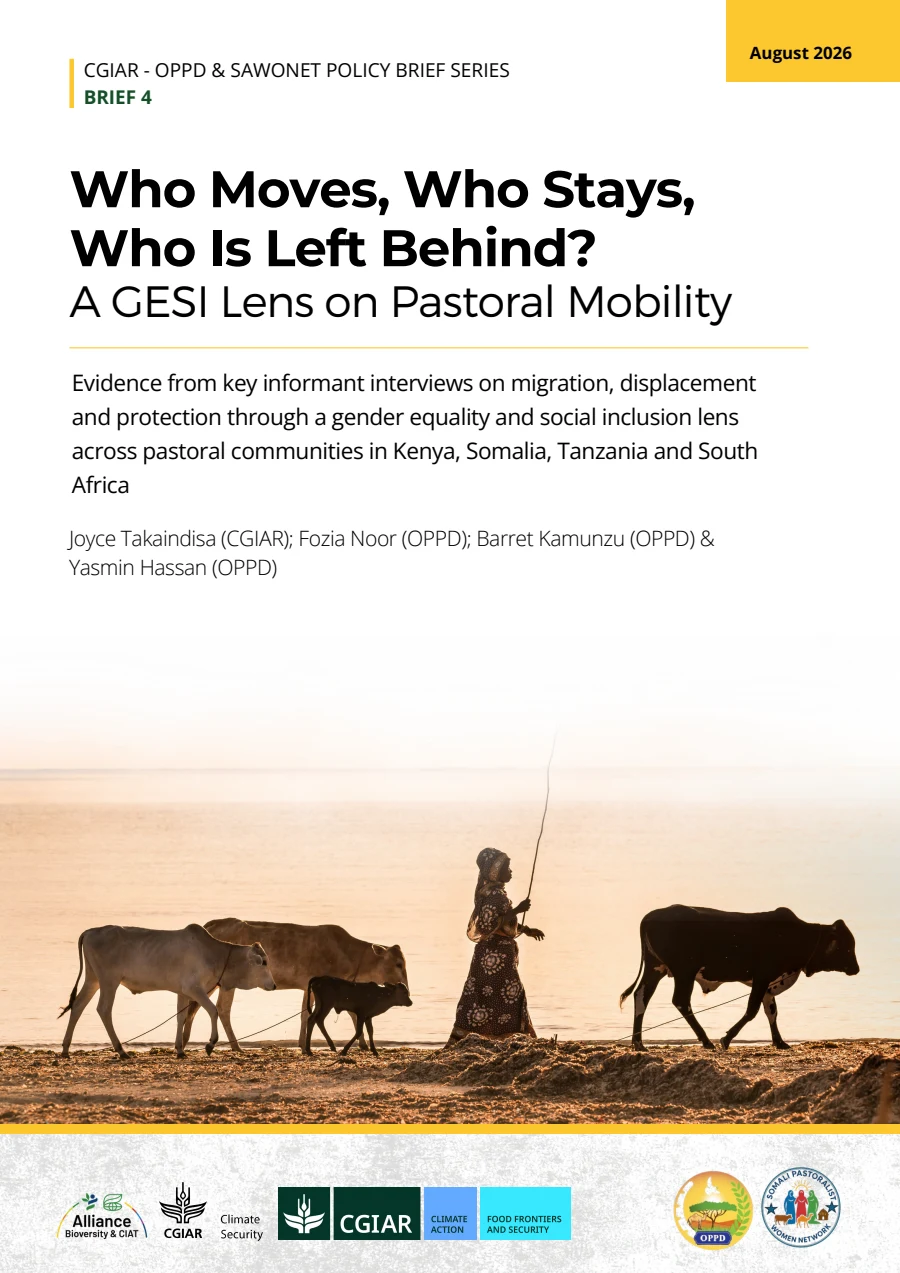
Who Moves, Who Stays, Who Is Left Behind? A GESI Lens on Pastoral Mobility
Evidence from key informant interviews on migration, displacement and protection through a gender equality and social inclusion lens across pastoral communities in Kenya, Somalia, Tanzania and South Africa
- Authors
- Joyce Takaindisa (CGIAR); Fozia Noor (OPPD); Barret Kamunzu (OPPD); Yasmin Hassan (OPPD)
- Series
- CGIAR, OPPD & SAWONET Policy Brief Series
- Research countries
- Kenya, Somalia, Tanzania, South Africa
- Publication
- August 2026 · Brief 4
- Format
- PDF · 17 pages · 13.7 MB
Executive summary
Pastoral mobility is a livelihood strategy, but climate stress and conflict are changing its routes, duration and conditions. Applying a gender equality and social inclusion (GESI) lens, the brief distinguishes the experiences of women who move, remain behind or are displaced involuntarily. Gender, age, disability, marital status and household position shape access to rights, services and protection. Policy must respond to these differences and sustain protection after arrival in settlements.
Condensed from the original brief. Read the PDF for the complete evidence, analysis and references.
Key findings
- Planned seasonal movement coexists with longer migration routes, urban migration, cross-border movement and displacement into settlements; patterns vary across national contexts.
- Women and girls who move face violence, exploitation and barriers to services, while those remaining behind absorb household survival responsibilities with reduced support.
- Displacement can sever access to customary resource rights and informal social protection. Protection risks persist after arrival in camps and settlements.
- Disability, widowhood, age and minority-clan status compound exclusion; inaccessible infrastructure, communication and programme design create additional barriers.
Policy recommendations
- Design distinct responses for planned pastoral mobility, forced displacement, settlement and labour or educational migration, and resource support for women remaining behind.
- Fund sustained gender-based violence prevention and response in camps and settlements from their earliest stages.
- Preserve or restore displaced women's customary resource rights and social-protection systems.
- Use the Washington Group Short Set on Functioning for disability-disaggregated data and integrate the needs of women with disabilities into climate and displacement frameworks.
- Design protection protocols around intersecting vulnerabilities, including disability, age, widowhood and minority-clan status.
Citation & attribution
Takaindisa, J.; Noor, F.; Kamunzu, B.; Hassan, Y. (2026). Who Moves, Who Stays, Who Is Left Behind? A GESI Lens on Pastoral Mobility: Evidence from key informant interviews on migration, displacement and protection through a gender equality and social inclusion lens across pastoral communities in Kenya, Somalia, Tanzania and South Africa. CGIAR Climate Security, Organization for Pastoral Peace Development (OPPD).
Joint series: CGIAR, OPPD & SAWONET Policy Brief Series. The original citation identifies CGIAR Climate Security and Organization for Pastoral Peace Development (OPPD).
© 2026 CGIAR Climate Security. The original PDF retains all copyright notices, license statements, source citations, photo credits and institutional disclaimers.
Related publications
Explore the other available briefs in this joint series.